
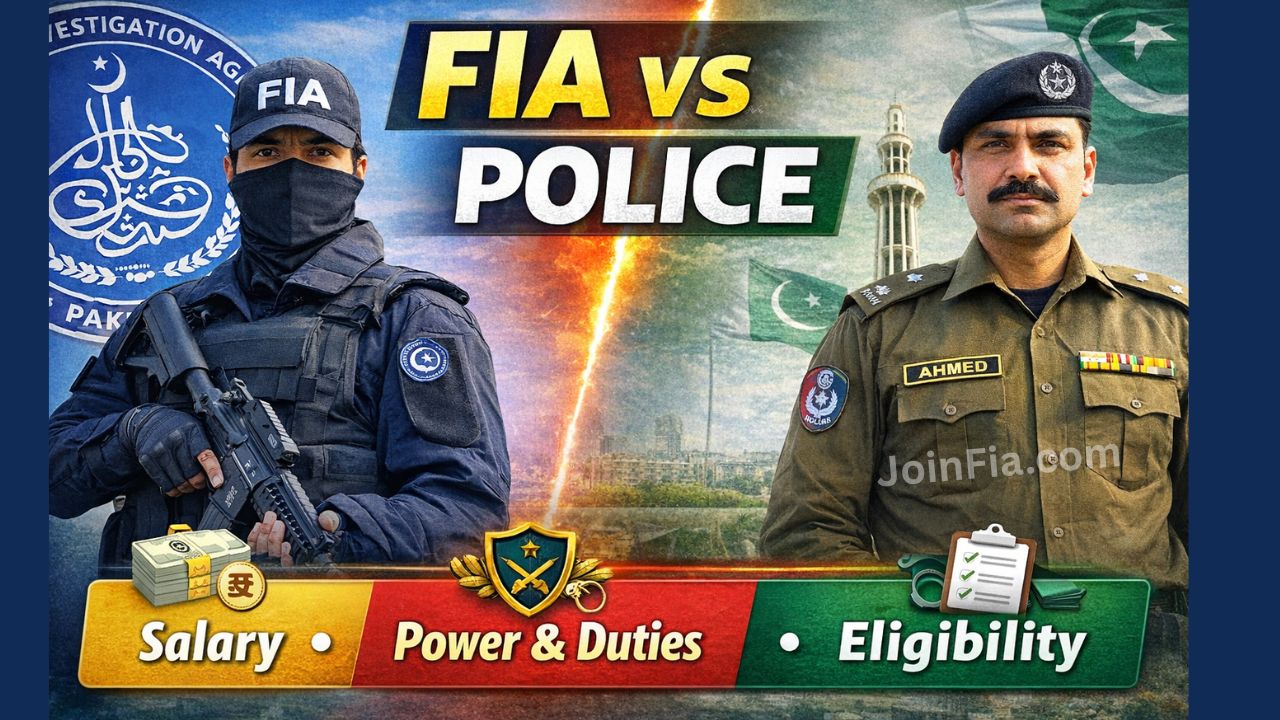
Choosing between FIA vs Police jobs in Pakistan is a common question among students and job seekers preparing for government careers. Both departments offer respect, authority, and stable salaries, but their salary structure, duty timing, domain of work, and career growth are quite different.
This detailed comparison guide explains the difference between FIA and Police jobs in Pakistan, including salary, power, duties, eligibility criteria, and working conditions in 2026.
Introduction to FIA and Police Jobs in Pakistan
Before comparing both departments, it’s important to understand their core roles.
What is FIA (Federal Investigation Agency)?
The Federal Investigation Agency (FIA) is a federal law enforcement agency working under the Ministry of Interior. FIA handles high-level and specialized crimes across Pakistan.
Major Responsibilities of FIA
- Cybercrime investigations
- Immigration and passport control
- Human trafficking cases
- Financial fraud investigations
- Anti-corruption support
- International crime investigations
FIA mainly focuses on investigation-based and intelligence-related work.
What is Police in Pakistan?
The Police Department is a provincial law enforcement force responsible for maintaining law and order within cities and districts.
Major Responsibilities of Police
- Maintaining public safety
- Crime prevention and patrolling
- Arresting criminals
- Traffic control
- Handling emergencies
- Crowd management
Police work is mostly field-based and public-facing.
FIA vs Police Salary Comparison 2026
Salary is one of the most important factors when choosing between FIA and Police jobs.
FIA vs Police Starting Salary (Estimated 2026)
| Rank/Post | FIA Salary | Police Salary |
|---|---|---|
| Constable | 75,000 – 82,000 PKR | 55,000 – 65,000 PKR |
| ASI | 82,000 – 95,000 PKR | 65,000 – 75,000 PKR |
| Sub Inspector | 95,000 – 110,000 PKR | 75,000 – 90,000 PKR |
| Inspector | 110,000 – 130,000 PKR | 90,000 – 110,000 PKR |
Key Salary Differences
- FIA salaries are usually higher than Police salaries.
- FIA officers receive federal allowances.
- Police salaries vary depending on province and duty location.
- FIA jobs generally offer better financial benefits.
Overall, FIA jobs are considered financially stronger compared to Police jobs.
FIA vs Police Duty Timing Comparison
Duty timing is another major difference between FIA and Police careers.
FIA Duty Timing
FIA duty hours are generally more structured:
- Mostly office-based duty
- Standard 8 to 9 hours shift
- Occasional overtime during investigations
- Less frequent night duties
FIA provides more balanced working hours.
Police Duty Timing
Police duty hours are more demanding:
- Long and irregular shifts
- Emergency-based duty system
- Frequent night shifts
- Public holidays often include duty
Police jobs require high physical stamina and flexibility.
FIA vs Police Domain of Work (Nature of Job)
The domain of work refers to the type of responsibilities handled by each department.
FIA Domain of Work
FIA work focuses on investigations and specialized crimes.
Typical FIA job duties:
- Cybercrime case investigations
- Immigration checking at airports
- Fraud and financial crime investigations
- Digital evidence collection
- Intelligence gathering
FIA jobs involve technical and investigative tasks.
Police Domain of Work
Police duties focus on law enforcement and public safety.
Typical Police duties:
- Patrolling streets
- Responding to emergency calls
- Managing protests and crowds
- Arresting suspects
- Maintaining law and order
Police jobs involve active fieldwork.
FIA vs Police Power and Authority
Power and authority depend on job rank and department structure.
FIA Power
FIA officers have authority to:
- Conduct investigations nationwide
- Arrest suspects in federal cases
- Handle cybercrime and immigration matters
- Work with international agencies
FIA authority is often technical and investigative.
Police Power
Police officers have authority to:
- Maintain law and order
- Arrest criminals locally
- Conduct raids
- Control public situations
Police power is more visible and field-based.
FIA vs Police Eligibility Criteria
Eligibility requirements are similar but vary slightly depending on the post.
FIA Eligibility Criteria
Typical requirements include:
- Constable: Matric
- ASI: Intermediate
- Sub Inspector: Bachelor’s Degree
- Inspector: Bachelor’s Degree
Other requirements:
- Age: 18–30 years
- Physical fitness required
- Written test and interview
Police Eligibility Criteria
Typical requirements include:
- Constable: Matric
- ASI: Intermediate
- Sub Inspector: Bachelor’s Degree
Other requirements:
- Age: 18–28 years
- Physical fitness required
- Written and physical tests
Eligibility requirements are almost similar in both departments.
FIA vs Police Promotion Opportunities
Promotion speed plays a major role in long-term career growth.
FIA Promotion System
FIA promotions are structured but slower.
Typical promotion path:
- Constable
- ASI
- Sub Inspector
- Inspector
- Assistant Director
Promotions depend on:
- Performance
- Seniority
- Department exams
Police Promotion System
Police promotions can be faster due to:
- Larger workforce
- More vacancies
- Department expansion
Typical promotion path:
- Constable
- Head Constable
- ASI
- Sub Inspector
- Inspector
Police promotions are often more frequent than FIA.
FIA vs Police Training Comparison
Training prepares candidates for real-world duties.
FIA Training
FIA training focuses on:
- Investigation techniques
- Cybercrime handling
- Intelligence operations
- Legal procedures
Training duration varies by post.
Police Training
Police training focuses on:
- Physical fitness
- Weapons handling
- Crowd control
- Law enforcement techniques
Police training is more physically demanding.
FIA vs Police Job Facilities and Benefits
Both departments provide government benefits.
Common Benefits
- Medical facilities
- Pension after retirement
- Government allowances
- Job security
- Housing benefits (in some cases)
FIA Additional Benefits
- Better office environments
- Federal-level allowances
- More structured working conditions
Police Additional Benefits
- Greater field experience
- Strong public authority
- Wide operational exposure
Both departments offer stable government careers.
FIA vs Police Job Risk Level
Risk level is an important factor to consider.
FIA Risk Level
FIA jobs usually involve:
- Investigation-related risks
- Office-based operations
- Less physical confrontation
Risk level is moderate.
Police Risk Level
Police jobs usually involve:
- Public confrontations
- Emergency situations
- Crowd control duties
Also Read About: FIA Recruitment 2026: Which Test is the Hardest?
Risk level is higher compared to FIA.
FIA vs Police – Which Job is Better in Pakistan?
The answer depends on your career goals and personal preferences.
Choose FIA If You Want:
- Better salary packages
- Fixed duty hours
- Investigation-based work
- Office-style environment
- Lower physical workload
FIA is ideal for candidates interested in technical and investigative careers.
Choose Police If You Want:
- Strong public authority
- Field-based work
- Faster promotions
- Action-oriented duties
- Community service roles
Police jobs suit candidates who prefer active fieldwork.
FIA vs Police – Quick Comparison Summary
Key Differences Between FIA and Police
Salary:
FIA generally offers higher salary packages.
Duty Timing:
FIA has more regular duty hours; Police duties are longer.
Domain of Work:
FIA focuses on investigation; Police focus on law enforcement.
Risk Level:
Police jobs are riskier than FIA jobs.
Promotion:
Police promotions may occur faster.
Final Verdict – FIA vs Police Jobs in Pakistan 2026
Both FIA and Police jobs in Pakistan are respected government careers offering long-term stability and benefits. However, they differ significantly in salary, duty timing, and nature of work.
- FIA jobs are best for candidates seeking higher salaries, structured duties, and investigative roles.
- Police jobs are ideal for those who enjoy fieldwork, public service, and active law enforcement duties.
Before choosing between FIA and Police careers, carefully consider your education level, physical fitness, career goals, and lifestyle preferences.
With proper preparation and dedication, both careers can provide a secure future and professional success in Pakistan’s law enforcement sector.